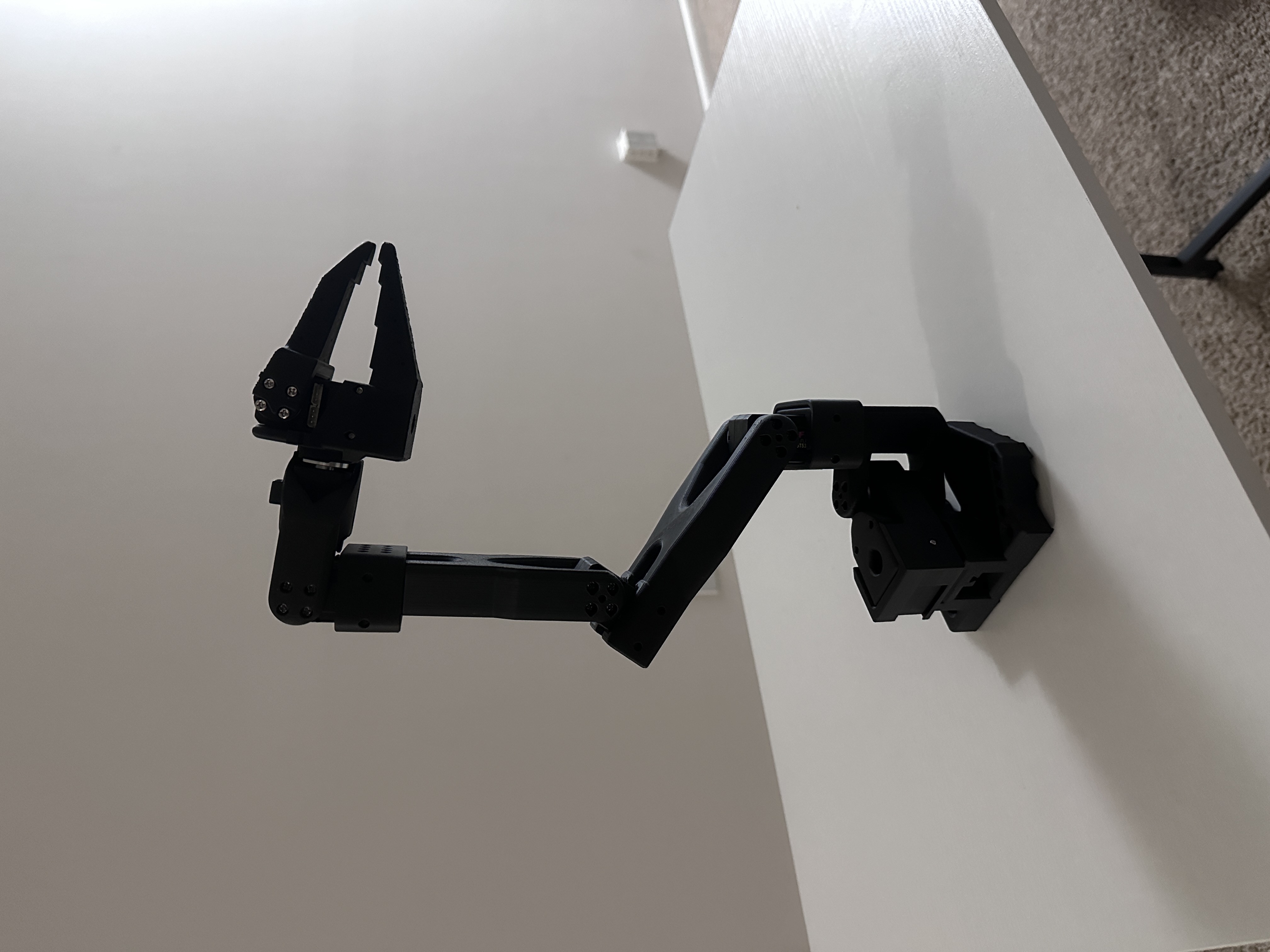
SO101 Robot
2025
Problem
Robot arms exist at two extremes: industrial arms are precise but cost tens of thousands of dollars and require specialized programming environments, while low-cost educational robots lack the software maturity to go beyond toy demonstrations. The SO101 is a rare open-source, ~$150 6-DOF arm with genuine research potential, but getting it from a kit of servo motors to a system capable of autonomous task execution requires integrating hardware assembly, motor calibration, vision, and imitation learning policy training from scratch. This integration barrier limits reproducibility in robotics research and makes it hard for individuals to experiment with embodied AI on a realistic budget. The objective was to build a fully operational SO101 setup capable of teleoperation and autonomous pick-and-place, and to document the process end-to-end.
Solution
Assembled the SO101 6-DOF arm from hardware, calibrated each servo motor to its torque and range limits, and integrated the system with HuggingFace's LeRobot framework. Set up a leader-follower teleoperation system using a second arm as the physical controller, enabling natural and low-latency demonstration collection without scripting individual movements. Recorded multi-episode demonstration datasets for pick-and-place tasks and trained imitation learning policies using ACT (Action Chunking with Transformers), which models multi-step actions as temporally coherent chunks rather than individual waypoints. Python was used throughout for its robotics ecosystem. LeRobot, OpenCV, and numpy provide a coherent stack from perception to control. The hardest challenge was calibrating software torque ceilings to prevent joint damage during out-of-distribution policy rollouts, especially at the wrist joint under load. I addressed this with a gradual warm-up protocol and per-joint torque monitoring during inference. The result is a reproducible, end-to-end embodied AI research stack running on commodity hardware for under $150.