Smart Investigator
AuxoAI · 2024
Problem
Industrial equipment failures at AuxoAI's clients generated investigation reports that routinely exceeded 1,000 pages, spanning sensor logs, maintenance histories, incident reports, and regulatory filings across multiple document versions. Root-cause analysis required engineers to manually cross-reference all of it, a process that consumed three to five engineering days per incident. The bottleneck was the absence of any system capable of understanding technical domain language, correlating evidence across documents, and producing a structured causal summary. The objective was to build an agentic AI system that could autonomously ingest these reports and surface root causes with production-grade accuracy.
Solution
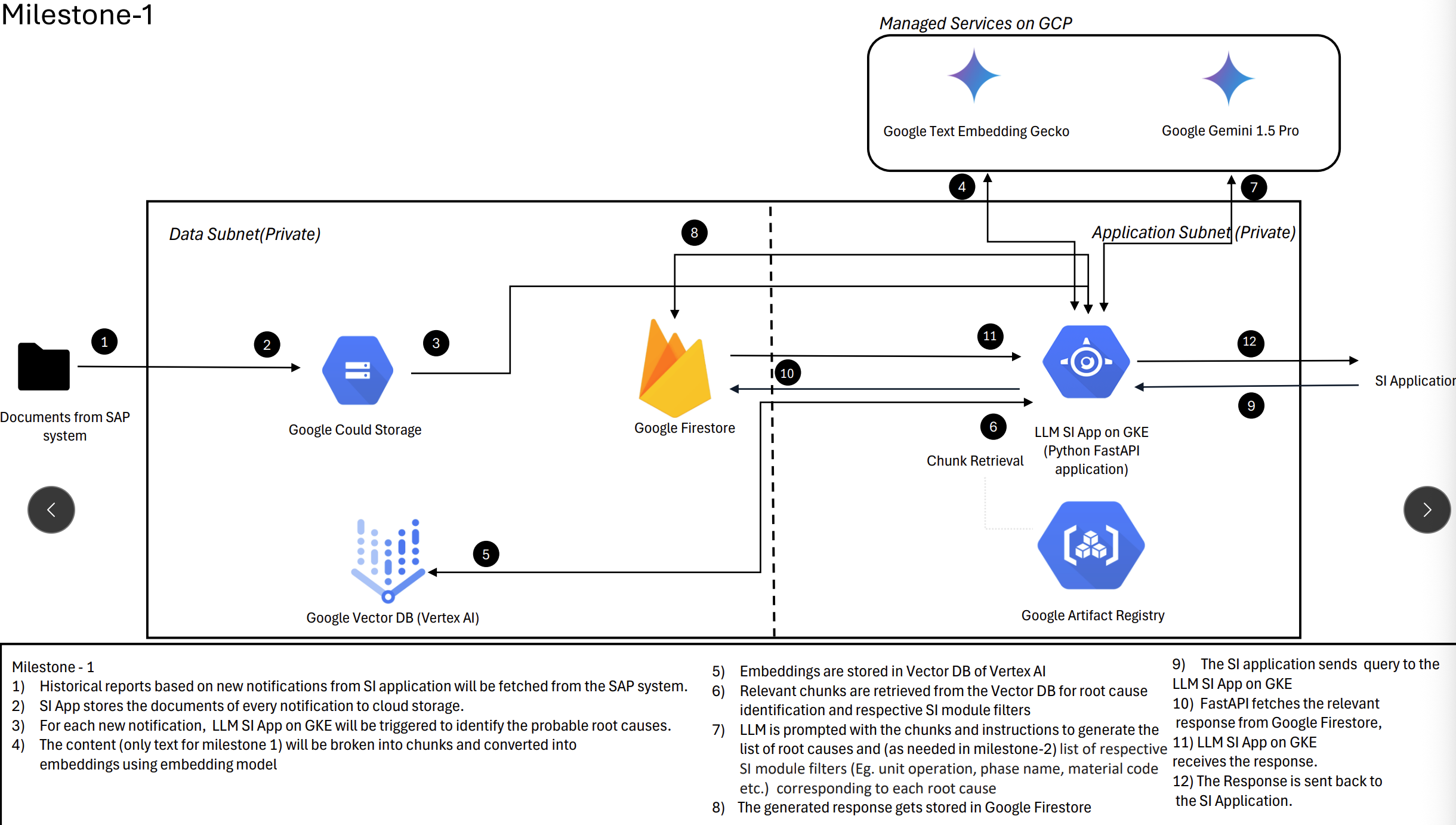
Designed and built a multi-step agentic pipeline on Google Cloud Vertex AI. Documents are preprocessed using a domain-aware segmentation strategy that preserves semantic boundaries: sensor tables are never split mid-row and failure timelines stay contiguous. Documents are then indexed into a managed vector store. An LLM agent orchestrates a multi-turn retrieval loop: it formulates targeted sub-queries, retrieves and evaluates evidence, iteratively refines its causal hypothesis, and produces a structured root-cause report with source citations. Vertex AI was chosen over self-hosted alternatives for its managed vector search and native LLM integration, enabling rapid iteration without infrastructure overhead. The hardest problem was handling conflicting evidence across document versions, where sensor logs and maintenance records sometimes contradicted each other. I solved this by a confidence scoring module that ranks competing claims by recency and source authority and explicitly flags ambiguity for human review. The system achieved 96% root-cause accuracy on a held-out test set of historical cases and reduced average investigation time from days to under 30 minutes.