LilSeeGround
Can a vision-language model small enough to ride on a robot find “the chair left of the TV” in a 3D scan? I swapped the 72B model inside a state-of-the-art pipeline for 2B and 4B ones. The 4B model did better.
- Role
- Led the project · team of 3
- With
- Vu Nguyen, Sarang Rajeev
- When
- Winter 2026 · University of Michigan
- Stack
- Qwen3-VL · vLLM · PyTorch3D
- Paper
- Read the PDF ↗
- Code
- GitHub ↗
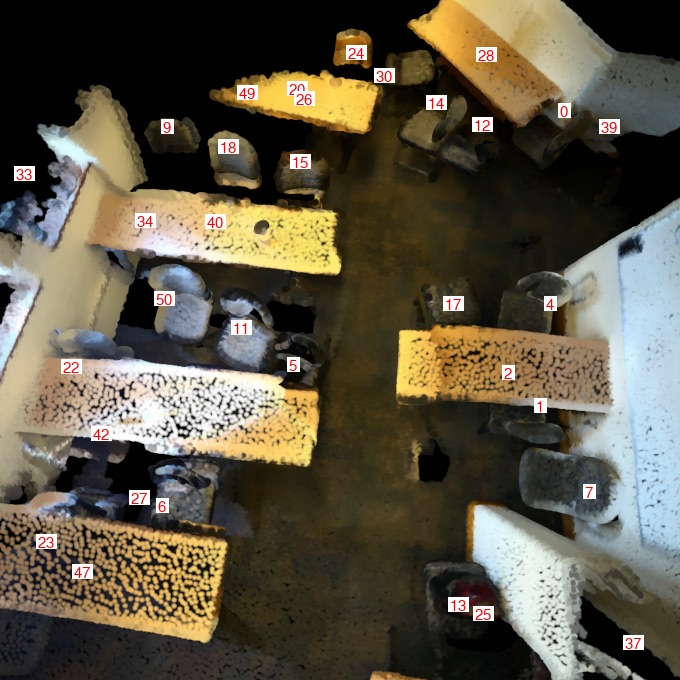
there is a beige wooden desk. placed on the side of the wall.
Is the accuracy cliff about size, or about age?
3D visual grounding means pointing at the right object in a 3D scene from a sentence: “the brown ottoman in front of the sofa.” A home robot or an AR headset needs it before it can act on an instruction.
SeeGround (CVPR 2025) does this without training any 3D model. It renders the scene into an image, numbers every object, and asks a vision-language model which number matches. It’s clever, and it runs on Qwen2-VL-72B: about 144 GB of GPU memory, four A100s, a kilowatt or two. No robot carries that.
SeeGround’s own ablation shows that shrinking the model hurts: a 7B model from the same family loses about 11 points. But that compares models of the same generation. I wanted to know whether a newer, much smaller model could close the gap.
Swap one part, hold everything else fixed
- 01Parse the queryAn LLM pulls out the target object and the anchor it’s described relative to.
- 02Pick a viewpointA virtual camera is placed to look at the anchor, the way a person would.
- 03Render with IDsThe 3D point cloud becomes a 2D image, with every object stamped with a number.
- 04VLM picks a numberImage + a table of object positions go to the VLM, which answers with an ID.72B → 4B / 2B
I replaced Qwen2-VL-72B with Qwen3-VL at 2B and 4B, served with vLLM. Prompts, viewpoint selection, rendering and the object table (built from Mask3D instance predictions) stayed identical, so any change in accuracy comes from the backbone.
Why Qwen3-VL? It’s a drop-in successor with the same input format, and it changes how the model encodes position: Interleaved-MRoPE spreads height, width and time signals across attention heads instead of splitting them. SeeGround’s whole trick is a picture with small numbers at precise pixel locations, so finer spatial encoding should matter more here than raw size.
The 4B model beats the 72B baseline
| Backbone | Params | VRAM | Unique@25 | Unique@50 | Multiple@25 | Multiple@50 | Acc@25 | Acc@50 |
|---|---|---|---|---|---|---|---|---|
| Qwen2-VL-7B † | 7B | 14 GB | — | — | — | — | 33.30 | — |
| InternVL2-8B † | 8B | 16 GB | — | — | — | — | 34.30 | — |
| InternVL2-26B † | 26B | 52 GB | — | — | — | — | 38.00 | — |
| Qwen2-VL-72B † | 72B | 144 GB | 75.70 | 68.90 | 34.00 | 30.00 | 44.10 | 39.40 |
| Qwen3-VL-2B (ours) | 2B | 4 GB | 73.03 | 68.54 | 32.07 | 29.22 | 42.41 | 39.15 |
| Qwen3-VL-4B (ours) | 4B | 8 GB | 74.16 | 67.98 | 38.14 | 34.35 | 47.23 | 42.84 |
Crowded rooms and look-alike objects
Both models still miss when a room is full of near-identical things and the sentence leans on fine spatial detail. And the smaller model isn’t strictly worse: switch the demo above to “2B right” to see queries the 2B model got and the 4B model didn’t.
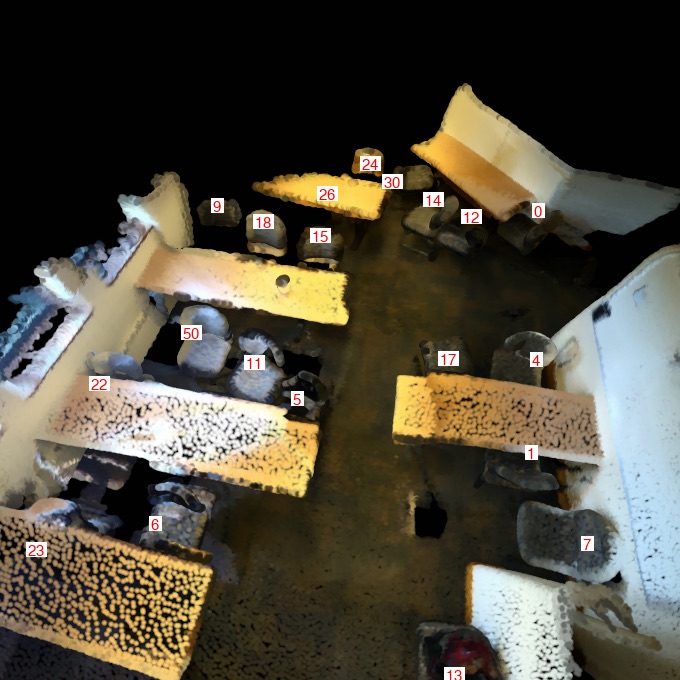
“there is an office chair. placed on the side of the wall.”
Both wrong · IoU 4B 0.00 · 2B 0.00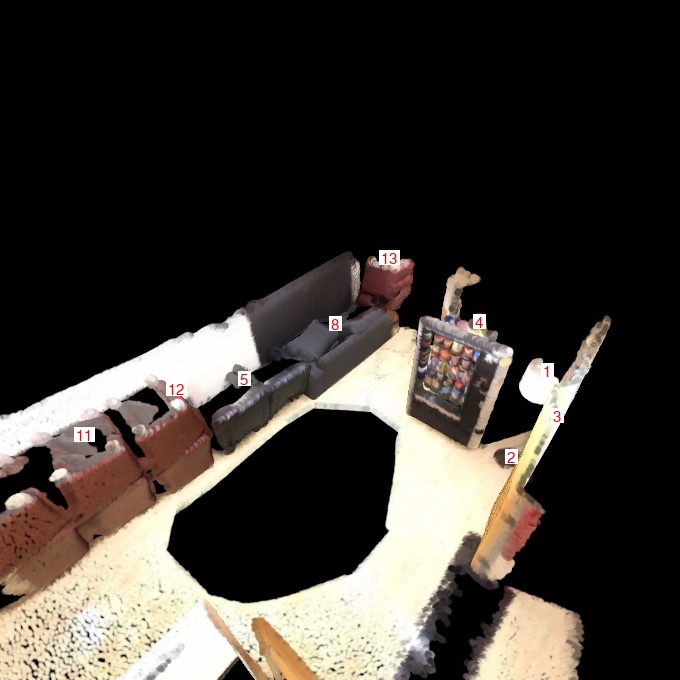
“there are two black chairs situated between six brown chairs and a black couch. this black chair is next to the black couch. it appears to be leather. it is black. there is a snack machine on the opposite wall.”
Both wrong · IoU 4B 0.01 · 2B 0.01Working on perception for robots or edge devices? I’d love to compare notes.